Best Water Softeners for Well Water in 2026
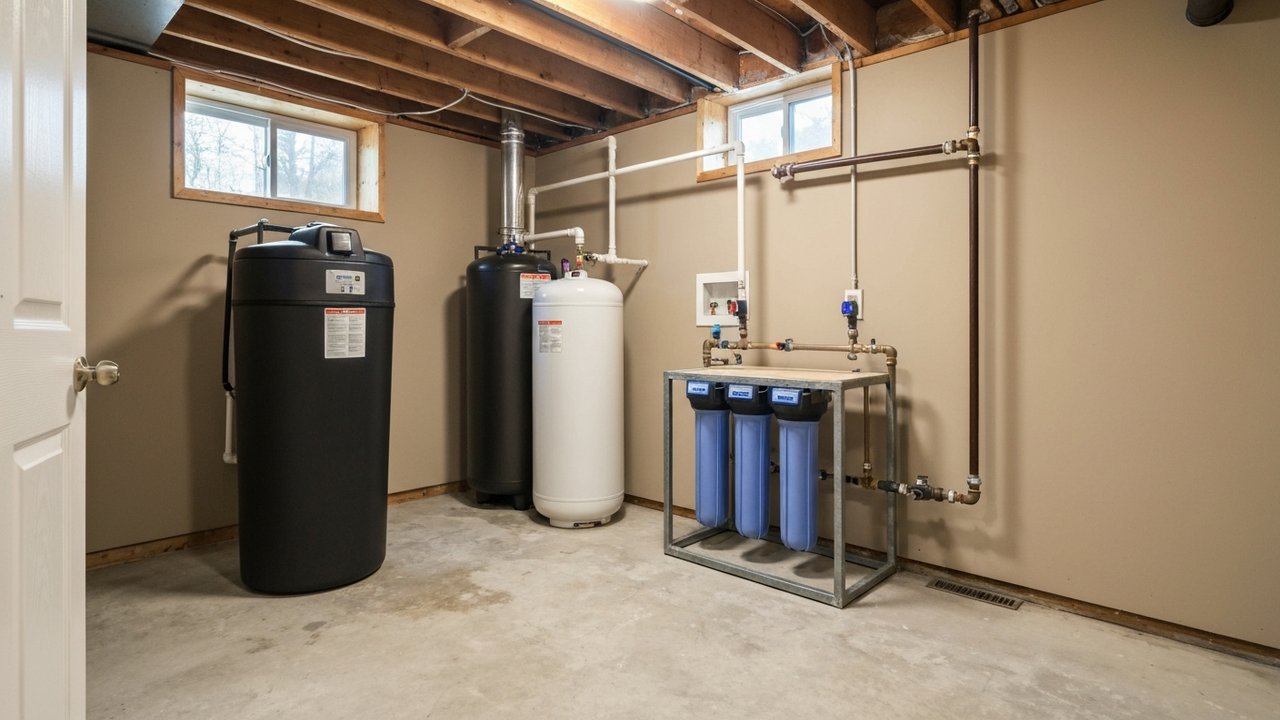
Test Your Well Water Before You Buy Anything
A municipal customer can look up a city water report. As a well owner, you are your own water utility, so the only way to choose the right equipment is to test. The CDC and EPA recommend testing private wells annually for bacteria, nitrate, and pH, and at least every few years for hardness, iron, manganese, sulfate, and chloride.
For softener shopping, you need three numbers from a certified lab test or a quality home kit: hardness in grains per gallon (gpg), iron in parts per million (ppm), and manganese in ppm. According to the Water Quality Association, water is soft below 3.5 gpg, moderately hard from 3.5 to 7, hard from 7 to 10.5, and very hard above 10.5. One grain per gallon equals 17.1 mg/L, so if your report lists hardness as mg/L or ppm, divide by 17.1 to get grains.
Iron matters because standard softener resin can remove only small amounts before it fouls and loses capacity. Iron above 0.3 ppm causes rusty staining, and manganese above 0.05 ppm causes black staining. These show up together far more often on well water than on city water, which is exactly why well-water buyers cannot just grab whatever softener tops a generic list.
Salt-Based vs Salt-Free: The Honest Difference
This is the single most misunderstood part of softener shopping, so here is the plain truth.
A salt-based ion-exchange softener runs your water through resin beads that swap calcium and magnesium (the hardness minerals) for sodium. Periodically the resin regenerates by rinsing with a brine solution. This genuinely removes hardness. You will feel slicker water, see less scale, and use less soap.
A salt-free conditioner (often marketed as a “salt-free softener”) does not remove anything. It uses a process like template-assisted crystallization to change the form of the minerals so they are less likely to stick as scale. The minerals are still in the water. Your hardness number does not drop. Conditioners can be a reasonable, low-maintenance choice for moderately hard water where the main goal is reducing scale, and they need no salt, no electricity, and no drain. But if you have very hard well water or you want true soft water for soap and appliances, a conditioner will disappoint you. Anyone selling a salt-free unit as a true softener is stretching the term.
Sizing: Hardness Times Household, Not Guesswork
Softeners are rated in grains of capacity. To size one, estimate how many grains of hardness your home removes per day, then choose a unit that regenerates roughly weekly rather than constantly.
The math is simple. Multiply the number of people in your home by about 75 gallons per person per day, then multiply that by your hardness in gpg. A family of four at 15 gpg removes about 4,500 grains a day, or roughly 31,500 grains a week, so a 32,000 to 40,000 grain unit fits well. If you also have measurable iron, add about 4 to 5 grains of demand per ppm of iron, because iron consumes softening capacity too. Oversizing slightly is fine and improves salt efficiency; undersizing forces frequent regeneration and wears the system out faster.
What NSF/ANSI 44 Certification Actually Tells You
Look for NSF/ANSI 44, the residential cation-exchange water softener standard (the Water Quality Association runs an equivalent program). Certification means an independent lab verified the materials are safe for drinking water, the tank holds up structurally, the brine system meters accurately, and the unit delivers its rated softening capacity. It is real third-party proof, not a marketing claim.
One nuance worth knowing: basic NSF/ANSI 44 certification does not by itself require efficiency. There is a separate voluntary “efficiency-rated” designation. To earn it, a softener must be demand-initiated and must remove at least 3,350 grains of hardness per pound of salt. An efficiency-rated, metered unit uses less salt and less water, which is better for your wallet and, as you will see, better for your septic system.
The Septic Angle: Modern Softeners Are Fine
Well-water homes almost always have a septic system too, and you have probably heard that softener brine can harm a septic tank. The research is reassuring when the equipment is modern and efficient. The Water Quality Association, working with the National Onsite Wastewater Recycling Association, concluded that softener regeneration discharge can be safely sent to a properly functioning septic system. Studies have even found that efficiently operated softeners (removing 3,000 to 4,000 grains per pound of salt) can improve septic settling.
The key is to avoid old-style time-clock softeners that regenerate on a fixed schedule whether you need it or not. Those over-regenerate, waste salt, and dump unnecessary brine. A demand-initiated (metered) softener only regenerates based on actual water use, keeping the salt load on your septic system low. Choose metered, keep your tank on its normal schedule, and you are in good shape. For background on tank care, see our guides on how often to pump a septic tank and the signs your septic tank is full.
Specific Softeners Worth Considering in 2026
These are popular, well-reviewed options. Match the unit to your test results, and confirm the current certification and specs on the listing before buying.
AFWFilters Iron Pro 2 (Fleck 5600SXT valve). The go-to for well water that has iron. It combines softening resin with fine-mesh iron resin and a digital metered valve, handling hardness plus iron and manganese up to several ppm and some sediment. Available in 32k to 80k grain sizes. Pros: tackles the classic well-water iron problem in one tank; durable Fleck valve. Cons: not a substitute for a separate iron filter at very high iron; some assembly. Check price on Amazon
Fleck 5600SXT (standalone, often with 10% crosslink resin). A workhorse metered valve sold by many builders. The 10% crosslink resin resists chlorine and iron fouling better than standard 8% resin, which suits well water. Pros: reliable, repairable, widely supported. Cons: DIY-leaning; standard versions are for hardness, not heavy iron. Check price on Amazon
SpringWell SS. A polished, app-controlled salt-based system that performs strongly on hardness and handles modest iron. Pros: easy setup, good warranty, low-maintenance head. Cons: premium price; very high iron still wants dedicated filtration. Check price on Amazon
Whirlpool WHES40 (and similar WHES series). A compact, NSF-certified single-tank demand softener sized for households of one to six. Pros: affordable, certified, sold everywhere, simple. Cons: limited iron handling; built more for city or low-iron well water. Check price on Amazon
GE softeners (GXSH/GXMH series). Solid mainstream metered units with self-cleaning sediment filters on some models. Pros: certified, accessible support, good value. Cons: best for low-to-moderate iron. Check price on Amazon
Pentair / Pelican and Aquasure. Pentair (which absorbed Pelican) offers both salt-based softeners and salt-free conditioners; Aquasure’s Harmony line is a budget-friendly metered softener. Pros: range of options and price points. Cons: read carefully so you do not buy a salt-free conditioner expecting true softening. Check price on Amazon
If your iron is high, the most reliable setup is a dedicated iron filter ahead of a standard softener, rather than asking one tank to do everything.
This article is educational and is not professional water-treatment, plumbing, or health advice. Test results vary by well, so confirm your numbers and equipment certifications before purchasing. For more on living with a well and septic system, start at our homepage.
FAQ
Will a water softener hurt my septic system? Not if it is a modern demand-initiated (metered) unit. Industry research from the WQA and NOWRA shows efficient softeners discharge safely to a working septic system and may even aid settling. Avoid old time-clock models that over-regenerate.
Do salt-free systems really soften water? No. Salt-free conditioners change how minerals behave to reduce scale, but they do not remove hardness, so your grains-per-gallon number stays the same. Only salt-based ion exchange actually softens.
What if my well water has iron? Choose a combination softener with fine-mesh iron resin (such as the AFWFilters Iron Pro 2) for low-to-moderate iron, or add a dedicated iron filter ahead of the softener for higher levels. Test first so you know your exact iron ppm.
What size softener do I need? Multiply household members by about 75 gallons per day, then by your hardness in gpg, and add roughly 4 to 5 grains per ppm of iron. Pick a capacity that regenerates about weekly. A typical family lands on a 32,000 to 48,000 grain unit.
- Water Softener Sizing Calculator Get a recommended grain capacity and estimated annual salt cost, with every step of the math shown.
Know what septic service should cost
Before you call a company, it helps to know the typical price for pumping, repair, and replacement so you can spot a fair quote. Our cost guide breaks it down.
See septic cost guide →